Building Digital Banking Channels Around an Existing Core

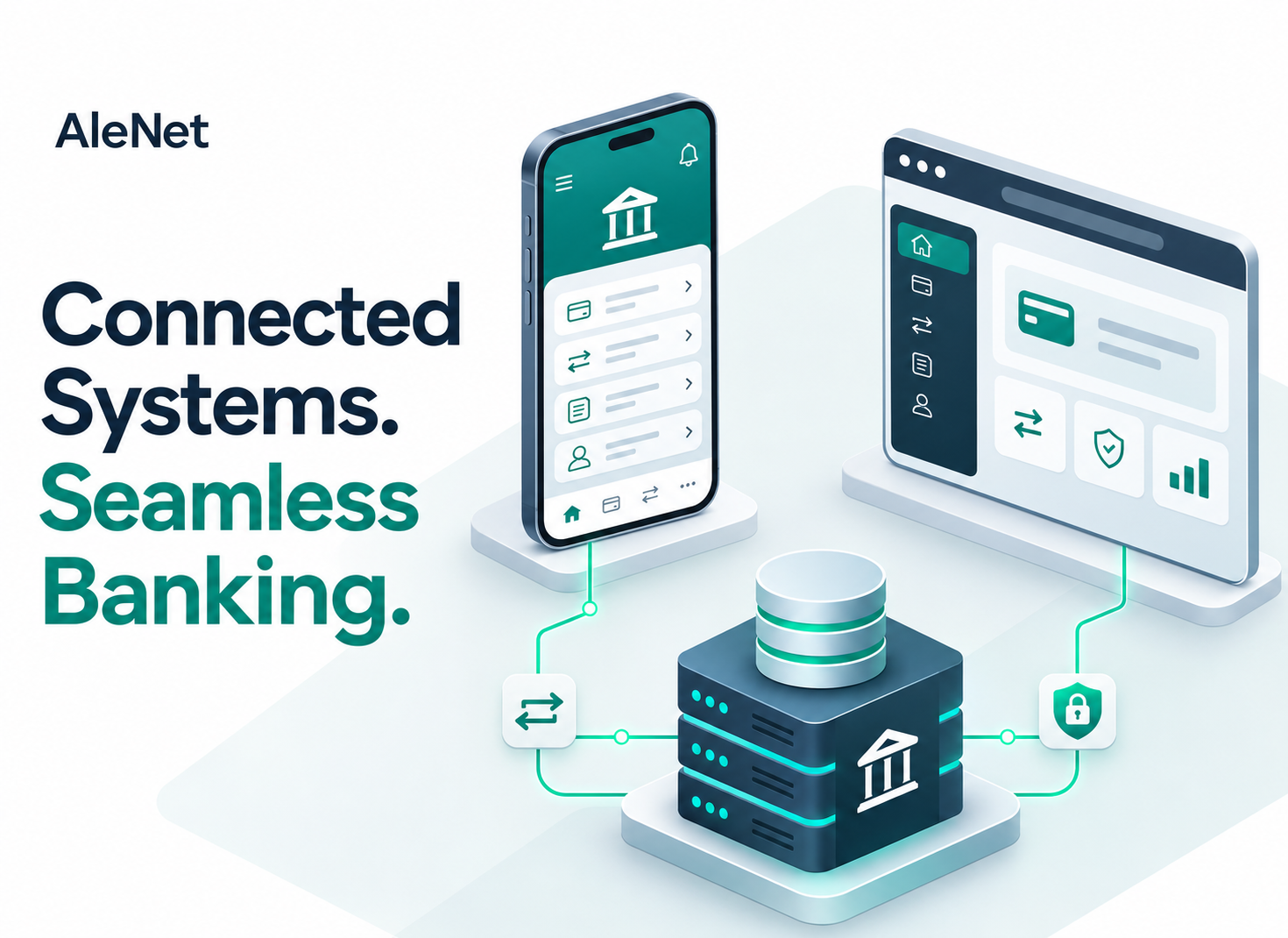
For a banking customer, checking a balance or making a transfer should feel straightforward. Behind that experience, several systems must exchange information, apply business rules and communicate the outcome accurately. The quality of the digital channel depends on how well those elements work together.
Developing mobile and online banking channels around an existing core banking system requires careful coordination between product design, backend engineering, integrations, testing and operations. A polished interface matters, but it is only one part of the complete service.
At AleNet, our experience includes developing mobile and online banking channels on top of existing core banking infrastructure, including transfer functionality, customer-facing interfaces and system integrations. That experience informs a practical approach: understand the complete customer journey and the systems supporting it before deciding how to implement individual features.
1. Start with a complete customer journey
A requirement such as “allow customers to transfer money” leaves many questions unanswered. Which accounts are eligible? What information must the customer provide? When should validation happen? What happens if the request is accepted but the final outcome is delayed?
These questions connect customer experience with business rules and system behaviour. They should be resolved together rather than passed between teams as separate concerns.
Mapping the journey helps identify dependencies early. It also creates a shared reference for designers, developers, testers and business stakeholders. Everyone should understand what the customer sees, what each system does and how exceptions are handled.
2. Understand the existing environment
An established bank already operates within a network of systems, processes and responsibilities. The core platform may connect with payment services, identity systems, reporting tools and operational applications. A digital channel must fit into that environment.
Discovery should establish which systems own particular information, which interfaces are available and where business rules are applied. It should also identify access constraints, documentation gaps and dependencies on internal or external teams.
This investigation reduces the risk of designing functionality around assumptions that cannot be supported by the existing environment. It also helps distinguish changes the channel team can deliver independently from changes requiring wider coordination.
3. Make transaction status understandable
Customers need to know whether an action succeeded, failed or remains in progress. Ambiguous messages can lead to repeated attempts, unnecessary support requests and loss of confidence.
The interface should reflect what the connected systems actually know. A request being received does not always mean the underlying transaction has completed. Likewise, a communication interruption does not necessarily mean that no action occurred.
Agreeing on clear status definitions helps align the interface, backend and support process. The goal is to present an accurate explanation and an appropriate next step, especially when the outcome cannot be confirmed immediately.
4. Treat API behaviour as part of the experience
APIs are often discussed as implementation details, yet their behaviour directly affects customers. Slow responses, inconsistent errors or incomplete information can make an otherwise well-designed application difficult to use.
Integration planning should cover request validation, authentication, response handling, timeouts and error interpretation. Teams should agree on what happens when a dependency is unavailable and which failures can be recovered from safely.
Clear interface contracts also make collaboration easier. When the expected behaviour is documented, developers and testers can work against the same understanding. Changes to connected systems can then be assessed for their effect on the customer journey.
5. Design repeated actions carefully
People tap buttons twice, refresh screens and retry when they are unsure whether something happened. Mobile connections can also interrupt communication at inconvenient moments. These behaviours should be expected during design.
For transaction-related operations, teams need to determine how repeated requests are identified and handled. The right approach depends on the operation and the capabilities of the systems involved. Retrying every failed request automatically can create additional problems if the original outcome is unknown.
A useful design discussion asks: how can the application help the customer recover without creating an unintended second action? Answering that requires cooperation across the interface and backend.
6. Define security responsibilities early
Security needs to be considered throughout delivery. Authentication, permissions, session behaviour and the handling of sensitive information affect both architecture and user experience.
The project should establish who can perform each action, what information they can access and how sensitive operations are confirmed. Development and testing environments also need appropriate controls, particularly when teams collaborate across organisational boundaries.
Responsibilities must be clear between the bank, development partner, infrastructure team and any third-party providers. A well-defined scope helps ensure that important controls are assigned to an owner and included in acceptance discussions.
7. Include operational teams in the design
A digital service continues beyond the customer’s screen. Support and operations teams need to investigate questions, understand transaction status and resolve issues through approved processes.
These needs should be discussed during requirements gathering. What information is necessary to investigate a customer enquiry? Which actions require escalation? What records should be available, and who should be authorised to view them?
Considering operations early can reveal missing requirements that would otherwise appear after launch. It also helps connect technical functionality with the people responsible for keeping the service useful and dependable.
8. Test across system boundaries
Testing individual components is necessary, but it does not establish that the complete journey works. A customer action may pass through several services before reaching its final outcome.
End-to-end testing should follow representative journeys through the interface, backend and connected systems. It should include unsuccessful actions, delayed responses, interrupted sessions and inconsistent dependency behaviour where those scenarios can be tested appropriately.
Acceptance criteria should describe observable outcomes rather than simply confirming that a screen exists. This gives business stakeholders and technical teams a clearer basis for deciding whether a feature is ready.
9. Deliver through manageable milestones
A large digital banking scope becomes easier to evaluate when divided into coherent releases. Each milestone should deliver a complete, testable outcome with clear dependencies and acceptance criteria.
Prioritisation should consider customer value alongside technical readiness. A feature with substantial integration dependencies may require preparatory work before visible development can proceed. Making those dependencies explicit supports more realistic planning.
Regular demonstrations help stakeholders assess actual behaviour and provide feedback while changes remain manageable. They also create opportunities to resolve misunderstandings before those misunderstandings spread into later stages of the project.
10. Prepare for release and ongoing ownership
Launch planning should address more than deployment. Teams need to agree on monitoring, support responsibilities, incident communication, documentation and the process for subsequent changes.
External dependencies may affect release timing. Access approvals, infrastructure preparation and coordination with connected-system owners should therefore be tracked alongside development work.
Ongoing ownership is equally important. The organisation maintaining the service needs sufficient knowledge to investigate issues and assess future enhancements. A clear handover makes that responsibility easier to fulfil.
Connecting engineering decisions with business outcomes
The strongest digital channels emerge when customer experience, integration design and operational needs are considered together. Decisions about status messages, API behaviour and recovery flows all influence whether customers can complete their intended actions confidently.
For businesses selecting a development partner, useful discussions go beyond a technology list. Ask how the team investigates existing systems, handles uncertain transaction outcomes, tests integrations and prepares for operational ownership.
AleNet supports businesses with mobile applications, web platforms, backend systems and integrations. Our banking development experience reinforces a consistent principle: reliable digital services begin with a clear understanding of the journey, the connected systems and the responsibilities needed to deliver it.
Simon Mardios
Need some guidance? You've come to the right place. Here, you'll learn more about agency performance, verified client trust, and proven software partnership strategies.

.png)